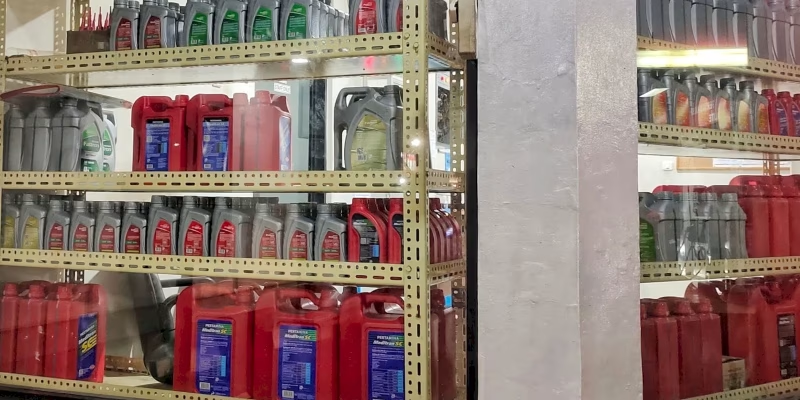
The first container is the cheapest lesson a distributor will ever buy, provided it is small. Most first-order problems are not chemical: they are a label in the wrong language, a drum count that does not fill the container, a certificate that names a lot nobody can find, or a payment released before anyone opened […]
Two categories arrived in 2016 to replace CJ-4 in different engines, and they are not interchangeable. CK-4 took over the mainstream fleet; FA-4 was written for a narrower set of engines designed to run on a thinner film. A distributor who treats FA-4 as “the newer CK-4” will eventually sell a drum into an engine […]
Diesel combustion makes acids. Some come from sulfur in the fuel, some from partially burned fuel and some from the oil oxidising in the sump, and all of them will attack bearing metals if nothing neutralises them. Total base number is that neutralising capacity, measured in milligrams of potassium hydroxide per gram of oil, and […]
Tanzania buys lubricants in a shape most first-time exporters do not expect: a small number of very large importers, a long tail of regional distributors, and a retail layer where the 1L bottle and the 20L pail live on the same shelf. The product mix follows the vehicles on the road, and that fleet is […]
Every container of engine oil arrives with a certificate of analysis, and most buyers read one line of it: the grade. That single line is the one a supplier can type by hand. The rest of the page is what tells you whether the drum in front of you came out of a reactor with […]
Both sequences sit in the same ACEA family, both are full-SAPS, both appear on bottles in the same warehouse, and both are routinely quoted as “the European spec”. They are not interchangeable, and the fault line is a single number: high-temperature high-shear viscosity.[1] Two Letters, Two Different Jobs A5/B5 is written for fuel economy in […]
Two drums stand side by side in a warehouse, both marked 40, both sold as diesel oil, and the price difference is twenty percent. Buyers assume the cheaper one is simply older technology. It is not: the two grades share the same hot-side viscosity window and differ almost entirely on the cold side and on […]
A distributor quoting a Kenyan fleet contract is not selling a brand, it is underwriting a duty cycle. Matatus, 14-tonne distribution lorries on the Northern Corridor and airport shuttle buses all enter through one port and answer to one standards body, yet they drain oil at wildly different rates. Get that mismatch wrong and the […]
Every private label conversation reaches the same question, and it is usually asked in the wrong form: what is your MOQ? The answer is not fixed, because the minimum order quantity is the sum of four constraints that have nothing to do with negotiation. Label printing has a minimum run. Blending has a minimum batch. […]
API SP and API SN describe two generations of the same petrol-engine category, and the difference is not cosmetic. SP was introduced in 2020 to answer problems that SN, written in 2010, was never designed to test: low-speed pre-ignition in downsized turbo engines, timing chain wear in engines with long oil intervals, and deposit control […]
Cote d’Ivoire imports most of the lubricant it consumes, and Abidjan handles the great majority of that volume. The commercial side of the trade is straightforward: find a supplier, agree a grade, book freight. The administrative side is where first shipments stall, because a container that arrives without the right pre-shipment documents becomes a storage […]
HTHS stands for high-temperature high-shear viscosity, and it is the closest laboratory stand-in for the oil film inside a loaded bearing at operating temperature. It is measured at 150 degrees Celsius under a defined shear rate, which is deliberately severe: hot enough to thin the oil, and sheared hard enough to strip out the viscosity […]
Nigeria is one of the largest diesel lubricant markets in West Africa, and the demand is shaped by three users rather than one: long-haul trucks on the northern corridors, generators running through grid instability, and construction equipment on road and housing projects. Each user wants a different balance of soot control, base number and price, […]
A price per litre is an answer to a question nobody asked. Wholesale engine oil quotations differ in base oil group, additive treat rate, pack size, licence status, delivery term and payment schedule, and each moves the real cost by more than the headline price suggests. Comparing quotes without normalising those fields is how a […]
ACEA C3 and C4 look like neighbours on a label and behave like different products under a particulate filter. Both sit in the low-SAPS family, both carry an HTHS floor of 3.5 millipascal seconds, and both are sold to the same kinds of buyers. What separates them is one ceiling: sulphated ash, capped at 0.8 […]
CI-4 and CK-4 are both heavy-duty diesel categories, and both still appear on drums today. CI-4 arrived in 2002 for engines with cooled exhaust gas recirculation. CK-4 arrived in 2016 with tighter limits on oxidation, aeration, shear and elastomer compatibility, and it was written for engines running hotter with tighter emission controls. Choosing between them […]
Ghana is a channel market. The ports at Tema and Takoradi bring the oil in, Accra and Kumasi move it inland, and the last mile is a dense network of auto parts shops, lube bays, workshops and fleet yards. An importer who lands a container and waits for buyers discovers that the margin was never […]
Two suppliers quote 15W-40 at different prices and the cheaper one loses. It happens because the comparison was made on the FOB number, and the FOB number excludes almost everything the buyer will pay. Landed cost is the only figure that can be compared across suppliers, Incoterms and pack sizes, and it is calculated per […]
The 5W in front of both grades is the cold-end promise, and it is identical. The difference sits after the W: a 30 and a 40 are different viscosity bands at 100 degrees Celsius, and the engine was designed around one of them. Asking which is better without naming the engine is like asking which […]
Ivory Coast is a diesel market with a petrol tail. The volume comes from trucks moving freight along the Abidjan corridor to Burkina Faso and Mali, from construction and port equipment, from generators that carry the load when the grid does not, and from a large fleet of diesel pickups and light commercials. Petrol cars […]