
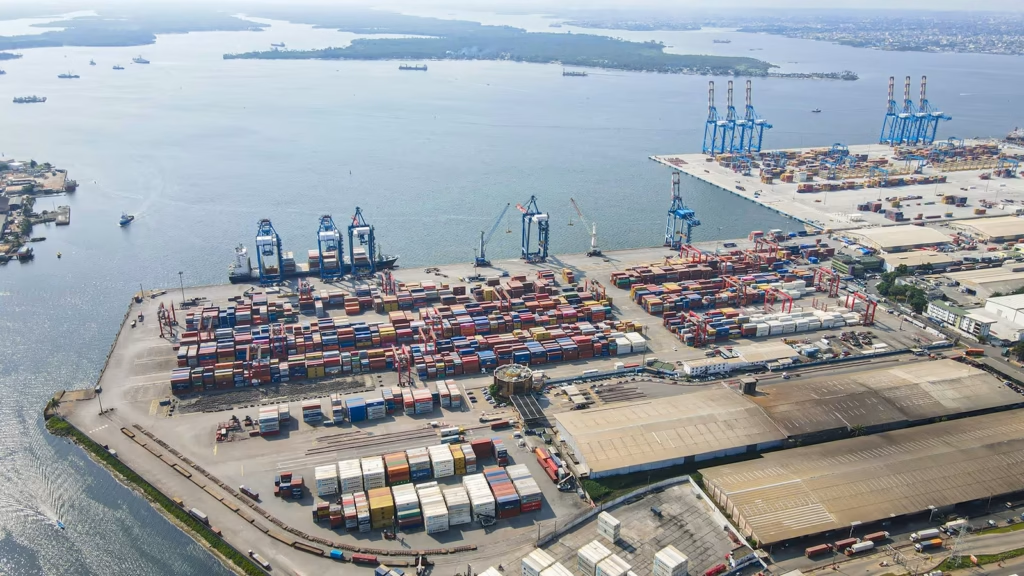
Cote d’Ivoire imports most of the lubricant it consumes, and Abidjan handles the great majority of that volume. The commercial side of the trade is straightforward: find a supplier, agree a grade, book freight. The administrative side is where first shipments stall, because a container that arrives without the right pre-shipment documents becomes a storage cost and a negotiation at the same time.
The checklist below should be ticked before the goods leave the loading port, not after they arrive.
Ivorian customs works from an electronic declaration supported by a document package: the commercial invoice, packing list, bill of lading, certificate of origin, product certificate of analysis and safety data sheet. On top of that sits the cargo tracking document that the authorities require for imports, which must be obtained before shipment and cannot be retrofitted at the port.
- Commercial invoice in the settlement currency, showing unit price, Incoterm and HS code.
- Packing list that matches the invoice line for line, including pack sizes and net and gross weights.
- Bill of lading with consignee details that match the importer of record exactly.
- Certificate of origin, which also settles preferential treatment under the regional tariff regime.
- Certificate of analysis for the batch, plus a safety data sheet in French for the product as supplied.
- Cargo tracking or pre-shipment verification document, obtained before loading.
None of these is exotic; what fails is consistency between them. A packing list that says 1,170 cartons when the bill of lading says 1,170 packages, or an invoice HS code that differs from the declaration, turns a routine clearance into an inspection.
Ivorian rules follow the regional pattern: product information in French, clear statements of grade and performance claims, net volume, batch number and the manufacturer or importer identity. A pack printed only in English can be held, and relabelling at the port is expensive. Settle it at the artwork stage: changes after printing cost more than the labels.
The performance claims must be claims the product can legally carry, and the grade has to match local demand, as set out in choosing oil for the Ivory Coast market. A CK-4 line that is unlicensed cannot display the API donut, and an OEM approval printed without the approval document is a liability rather than an asset. How the documentary side connects to the manufacturing side is covered in arranging export documentation.
The region applies a common external tariff, and lubricating oils sit in a duty band that should be confirmed against the current tariff schedule rather than assumed from an old proforma. Value added tax is charged at import and is recoverable for a registered business, which matters for cash flow: the tax is paid at the port and recovered later. Port charges, agency fees and inland haulage add to the cash requirement but not to the recoverable tax base.
| Stage | What is required | Who produces it | Common failure |
|---|---|---|---|
| Before loading | Cargo tracking document | Exporter or appointed agent | Applied for after sailing |
| Before loading | Certificate of analysis | Manufacturer, batch specific | Specification sheet sent instead |
| Before loading | French label artwork | Exporter with buyer approval | English-only packs |
| At arrival | Invoice, packing list, bill of lading | Exporter | Line items that do not reconcile |
| At arrival | Certificate of origin | Chamber of commerce | Origin declared incorrectly |
| At clearance | Customs declaration | Licensed broker | HS code that differs from the invoice |
Nine items, in order: confirm the HS code and duty band; confirm the cargo tracking requirement and how it is obtained; confirm French labelling against a proof; obtain the batch COA and safety data sheet; reconcile invoice, packing list and bill of lading before loading; confirm the Incoterm and who pays each port charge; budget VAT as cash and plan recovery; book a licensed broker before the vessel sails; agree claim terms for arrival quality and quantity.
Two of those items are worth extra attention. The first is the COA, because a specification sheet proves nothing about the batch in the container. The second is the claim terms, because the moment of truth is arrival, and a supplier without a written process will negotiate from convenience. How inspection is run is covered in quality inspection for importers, and how packing survives the voyage is covered in seaworthy packaging.
Market fit belongs in the same document. The grades that sell in Abidjan are not identical to those that sell in a European market, and a container of the wrong grade clears customs and then sits in the warehouse.
If-then: if the cargo tracking document has not been obtained before loading, then the shipment should wait. If the label is not in French, then fix the artwork before printing, not at the port. If the COA is for a different batch than the one shipped, then treat the shipment as unverified. If VAT recovery has not been modelled, then the landed cost is understated by the tax paid at the port.
Shipping a first container into Abidjan? Send the grade mix and the destination, and we will return the document checklist, the French label proof and the landed cost with the tax treatment laid out.
Can the cargo tracking document be obtained after arrival?
No. It is a pre-shipment requirement; getting it at the port is usually impossible and always expensive.
Is English labelling acceptable?
Not as a substitute. French product information is the working requirement, and a pack printed only in English risks being held.
Is VAT at import a real cost?
For a registered business it is recoverable, but paid in cash at the port, so it belongs in the cash-flow plan even when it is not in the final cost.