
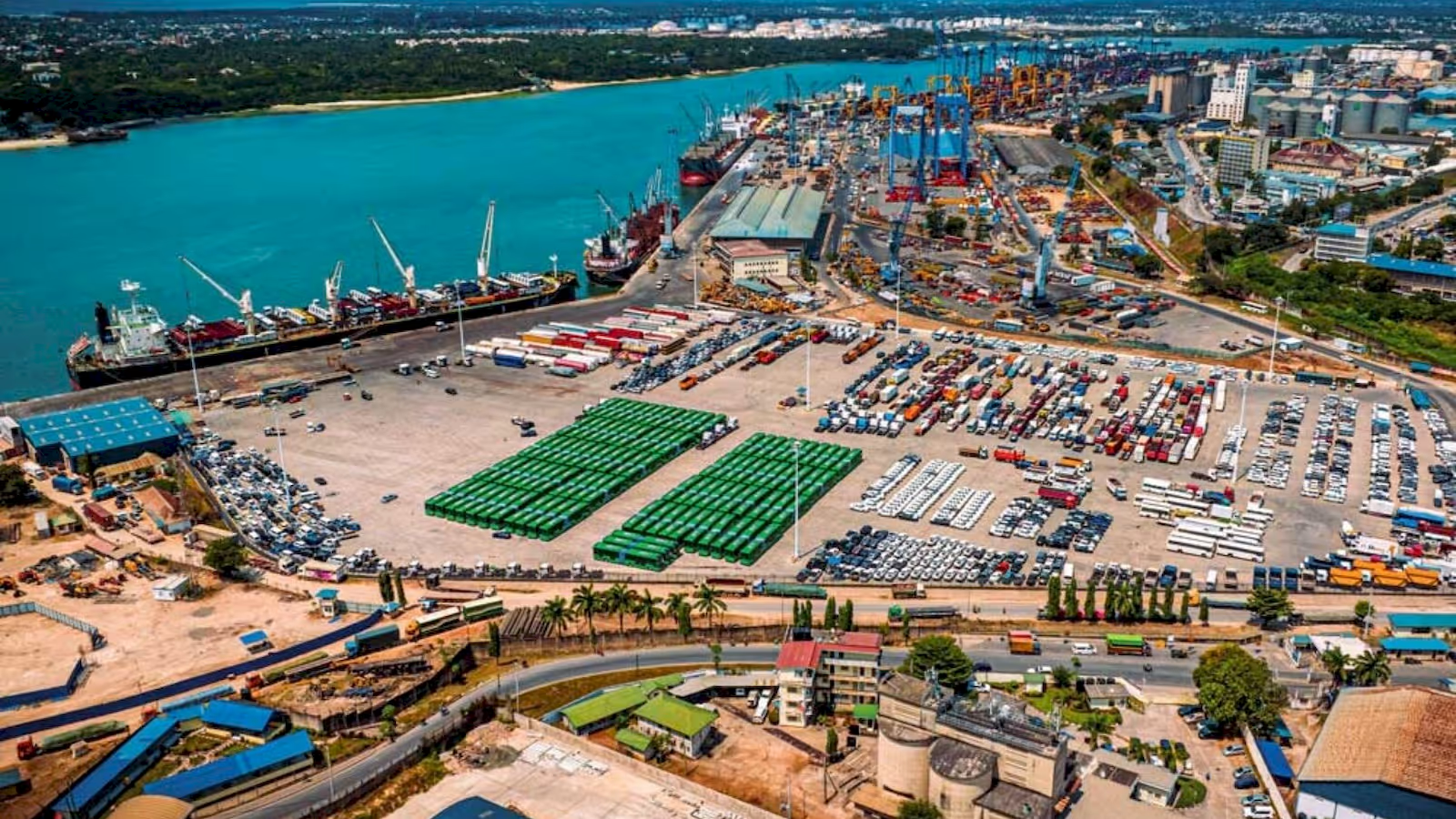
Tanzania buys lubricants in a shape most first-time exporters do not expect: a small number of very large importers, a long tail of regional distributors, and a retail layer where the 1L bottle and the 20L pail live on the same shelf. The product mix follows the vehicles on the road, and that fleet is dominated by Japanese and Indian trucks that were designed to run on a 15W-40 and will keep running on one.[1]
What Tanzania Imports, and Through Which Port
Dar es Salaam is the entry point for the great majority of finished lubricants, with a smaller flow overland from Kenya and, for the far west, through Kigoma and the lake corridors. Imports arrive as 200L drums, 20L pails and cartons of 4L and 1L bottles; drums dominate the commercial segment while cartons dominate retail, and the split between these packaging options decides both freight and shelf price. Landlocked neighbours also draw on the same port, so a Dar es Salaam price is partly a transit price.[2]
Standards and Pre-Shipment Checks at Dar es Salaam
Import consignments are subject to standards approval and, for regulated goods, pre-shipment verification through an appointed inspection body, which issues the certificate that clearance depends on. The practical consequence for an exporter is that the label, the declared grade and the batch COA must all agree before the container leaves the factory, because a mismatch discovered at the port is resolved with time and money, not with a phone call.[3] The export documentation set is the same one used for any African destination, in the same order.
Grades That Fit the Local Fuel and Fleet Mix
Diesel fuel quality varies across the market, so the engine oil has to carry the duty the fuel cannot. In practice: 15W-40 API CI-4 or CJ-4 for the bulk of trucks and buses, 10W-30 or 10W-40 for newer light commercial units, 20W-50 for older petrol engines and motorcycles, and 15W-40 for gensets. Selling a CK-4 into a fleet that still fills from high-sulfur forecourts adds cost without adding protection, so sourcing diesel engine oil starts with the fuel, not the drum.[1][4]
Cost Structure: Duty, VAT and Inland Freight
Landed cost stacks four layers: the EAC common external tariff band on the HS line, VAT on the duty-paid value, port and clearing charges, and inland transport to the distributor’s town. A drum that costs USD 100 at FOB can reach the shelf at USD 160–180 once duty, VAT, clearing and road freight are carried, and the distributor who forgets the last layer prices himself out of the upcountry market.[3][5] Choosing between retail, wholesale and fleet supply changes which of those layers you can pass on.
What a Local Distributor Needs From a Supplier
Beyond price: a stable grade list that matches the vehicles on the road, batch COA per lot, labels designed for a bilingual market, packaging that survives a tropical warehouse, and a supplier who can consolidate a mixed container of drums and cartons. A first order that arrives with three grades instead of eight sells through faster and proves the relationship at lower risk.[2][4]
| Segment | Typical duty | Product that fits | Main risk | What to verify |
|---|---|---|---|---|
| Trucks and buses | High load, long distance | 15W-40 CI-4 / CJ-4[1] | Oil life under dirty fuel | TBN and drain plan[4] |
| Light commercial pickups | Urban and regional | 10W-30 or 10W-40 CK-4[4] | Wrong spec for fuel | Fuel quality, OEM book[1] |
| Motorcycles and small engines | Short trips, air-cooled | 20W-50 or JASO MA2[4] | Clutch slip with car oil | JASO certification[1] |
| Gensets, hotels and hospitals | Low hours, long idle | 15W-40 CI-4[4] | Moisture and deposits | Load test records[2] |
| Retail cartons | Small packs, high turnover | 4L and 1L of the top two grades[3] | Slow-moving SKUs | Sell-through data[5] |
Frequently Asked Questions
Is Tanzania a big enough market for a first export? It is a consolidating market: fewer, larger importers and a long retail tail, so start with one distributor and one container.[2]
Which grades should a new distributor stock first? 15W-40 diesel, 20W-50 for older petrol and motorcycles, and one 10W-40 for newer units.[1][4]
Do labels have to be in Swahili? English is widely accepted, but a bilingual label sells faster and avoids relabelling cost later.[3]
How long does clearance take at Dar es Salaam? Budget a week or more for standards verification and duty, and do not schedule inland delivery against the vessel’s ETA.[5]