
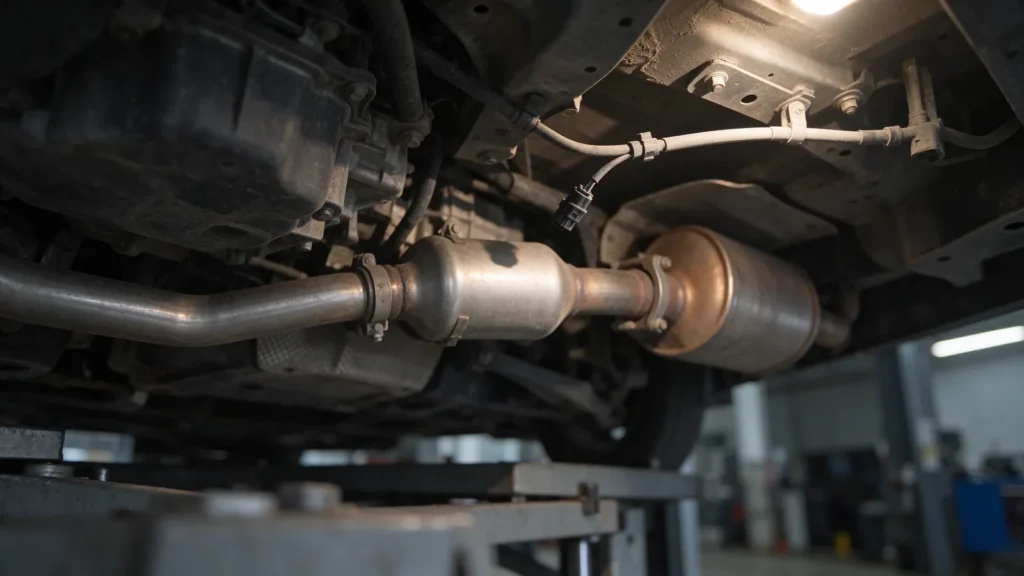
Low-SAPS is a statement about what an oil is not allowed to contain, and that makes it easy to sell and hard to understand. The three letters stand for sulphated ash, phosphorus and sulphur — the three residues that leave a permanent mark on a catalyst or a particulate filter. Cutting them protects the aftertreatment hardware. Cutting them also removes some of the cheapest anti-wear chemistry ever invented, so the formulator has to buy performance back somewhere else. Whether that trade is worth it depends on what sits downstream of the engine.[1][2]

If the Ash Number Sits at 0.5 Percent or Below, You Are in the Low-SAPS Tier
The industry splits the family into low-SAPS and mid-SAPS rather than treating “low” as a single value. The low tier keeps sulphated ash at or below roughly 0.5 percent by mass, with phosphorus and sulphur limits tighter than the mid tier. The mid tier allows up to about 0.8 percent ash, phosphorus between 0.07 and 0.09 percent and sulphur at or below 0.3 percent. Both tiers exist for filter and catalyst compatibility, and they differ in how much ash-free performance the oil must buy back.[1][3] Reading the acea letter without the number is how buyers end up with an oil that meets the family name and not the engine’s requirement, a distinction explained in the difference between C2 and C3.
Where SAPS Comes From and What It Protects Downstream
Sulphated ash is what remains after the oil burns: metal oxides from the additive package, mostly calcium, zinc and magnesium. Phosphorus comes from zinc dialkyldithiophosphate, the classic anti-wear additive. Sulphur arrives with both the additive chemistry and the base oil. All three pass through the exhaust and land on the catalyst washcoat or inside the filter wall. Ash cannot be regenerated away; it accumulates until the filter’s backpressure rises and the catalyst’s active surface is masked.[2] On a diesel particulate filter, that is a service-life issue, not a cosmetic one.
What You Give Up When Ash Goes Down: TBN and Anti-Wear Chemistry
Calcium and magnesium sulphonates are cheap base-number carriers as well as ash sources. Remove them and total base number falls, so the oil has less reserve against acidic combustion products over a long drain. Replace ZDDP and the anti-wear job moves to molybdenum, titanium and borate esters, which cost more and behave differently at high temperature. That is why TBN in a mid-SAPS oil is not simply a smaller version of TBN in a high-SAPS oil: the number and the chemistry behind it have both changed.[3]
When Low-SAPS Is Mandatory and When It Is Simply Expensive
Mandatory when the engine has a filter or a catalyst that cannot tolerate ash, which in practice means Euro 6 light diesel, gasoline direct injection with a GPF, and any engine whose handbook names a C-series approval. Unnecessary when the engine has no such hardware: an older port-injection gasoline unit or an industrial engine with no aftertreatment gains nothing from a low-ash oil and may lose wear protection, because the high-SAPS package it was designed around carried more ZDDP. The decision should follow the hardware, not the shelf label.[4]
Reading a COA for SAPS Without Guessing
Ask for three numbers and their methods: sulphated ash by ASTM D874, phosphorus by ASTM D5185 or equivalent, and sulphur by ASTM D4294 or D2622. Then ask whether the formulation is approved against a sequence or an OEM specification, and at which edition year. Without that, a COA proves the oil is inside a band; it does not prove the oil was tested in an engine. The same discipline applies to the safety file, where what importers should expect from an MSDS is a document that matches the batch, not a generic template.[5]
| Engine and aftertreatment | SAPS tier | Typical approval | Main risk | How to verify |
|---|---|---|---|---|
| Euro 6 light diesel, DPF | Mid-SAPS, ash ≤0.8%[1] | ACEA C3 or C5, OEM number | Filter ash loading | D874 result, approval year |
| TGDI gasoline, GPF | Mid-SAPS with LSPI evidence[2] | ACEA C6, OEM number | Pre-ignition, deposits | Sequence IX result |
| Heavy-duty diesel, no DPF | High-SAPS acceptable[4] | API CK-4 or CI-4 | Wrongly specified low-ash oil | TBN, ZDDP level in COA |
| Stationary engine, gas fuel | Low-SAPS often required | OEM stationary spec | Ash on spark plugs | Ash limit, plug service record |
| Legacy industrial engine | High-SAPS as designed | Manufacturer’s old spec | Wear from under-additised oil | Wear metals in oil analysis |
Frequently Asked Questions
Is low-SAPS the same as synthetic? No. SAPS describes ash, phosphorus and sulphur limits; synthetic describes base oil. A mineral-based oil can be low-SAPS and a full synthetic can be high-SAPS.[1]
Can a low-SAPS oil damage an older engine? It can increase wear where the engine was designed around a high-ZDDP package, because the replacement anti-wear chemistry is not equivalent in every duty cycle.[4]
Does lower ash always mean a longer filter life? It lowers the ash mass entering the filter, but soot loading and regeneration strategy still decide the service life.[2]
What ash figure should appear on the label? None is required by law in most markets; that is exactly why the COA and the approval number, not the label, are the documents to trust.[5]