
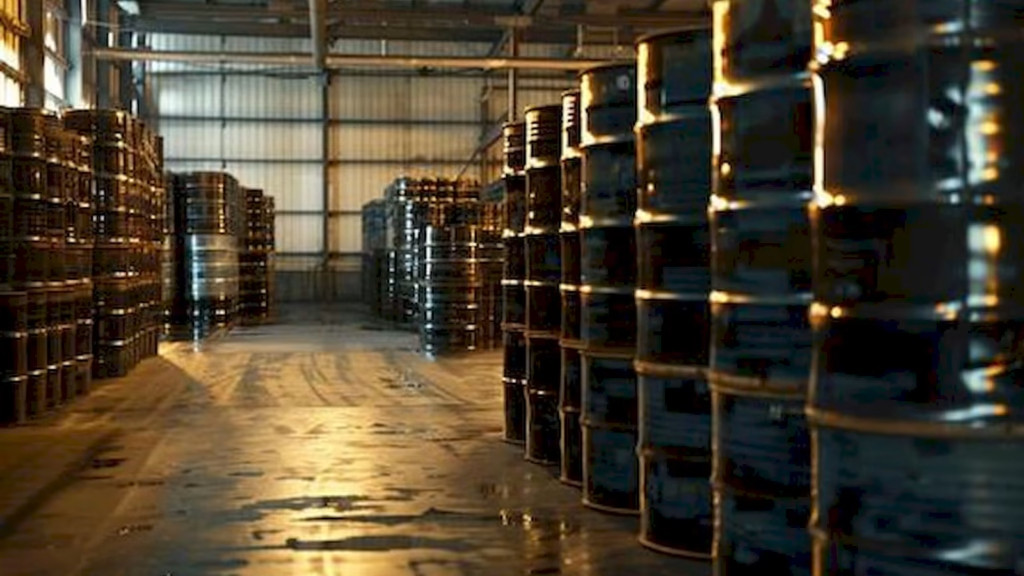
Engine oil has a shelf life, and how you store it decides whether that shelf life means anything. Heat, moisture, sunlight and contamination can degrade even a perfectly formulated oil between the day it lands in your warehouse and the day a customer pours it. Storing engine oil correctly before distribution is not a nicety — it is how you protect the product’s specification, your brand and your customers’ engines. This guide covers the storage conditions that matter and the habits that keep oil fit for sale.
The risk in storage is that the degradation is invisible. A drum of oil that has sat in direct sun for a year may look identical to a fresh drum while its viscosity, acid number and additive performance have drifted. Because engine oil is sold on specification, storage is really specification control. The three enemies are heat, water and contamination, and the solution is discipline, not expensive equipment.
Heat accelerates oxidation and ages the additives. Water ingress, through condensation or a leaky drum, degrades performance and promotes sludge. Contamination — dust, dirt, another product — changes the oil’s properties. Sunlight (UV) accelerates oxidation on exposed surfaces. Over time these push the oil off-spec even though it looks fine. The practical goal of storage is to slow all four: keep it cool, dry, sealed and covered.
| Degradation driver | What it does | Storage fix |
|---|---|---|
| Heat | Accelerates oxidation, ages additives | Cool, shaded warehouse |
| Water / humidity | Sludge, corrosion, off-spec | Sealed containers, dry storage |
| Sunlight (UV) | Oxidises exposed oil | Covered, not open-air |
| Contamination | Changes oil properties | Sealed, clean handling |
Storage ties directly into how long a product stays sellable — the shelf life and storage guide and the temperature and stored oil guide give the deeper detail on conditions and limits.
- Keep the warehouse cool, dry and shaded — target below 40°C, ideally well below, and away from direct sun.
- Store drums and pails upright on pallets, off the floor, so moisture doesn’t pool under the container.
- Keep containers sealed until the point of sale or filling — unseal only what you are about to distribute.
- Store indoors or under cover, never long-term in open air or sun.
- Keep the warehouse clean and dry to avoid contamination and condensation.
- Control access so containers aren’t damaged, moved roughly or opened casually.
The container is the first line of defence. Drums should be stored with their bungs sealed, and the top of a drum should never collect standing water — water can seep around the bung over time. Pails and bottles stay sealed until distribution. When you move stock, handle containers carefully so you don’t dent, puncture or distort them, because any breach opens the oil to contamination.
If-then: if you store drums, then store them upright with bungs sealed and on pallets off the floor, and never leave them out in rain or sun. If you store bottles and pails, then keep them in their original cartons, sealed, and rotate by batch date.
Engine oil is sold on batch date as much as on spec. Always rotate stock by batch date — sell the oldest first. This keeps every unit within its usable window and prevents the slow accumulation of old stock that silently passes its best-before. Tag pallets with the batch date on arrival and pull stock in order, not at random.
| Practice | Why it matters | How to do it |
|---|---|---|
| FIFO rotation | Sells freshest window first | Tag batch date, pull oldest first |
| Batch tagging | Know each unit’s age | Label pallets on arrival |
| Stock records | Track what’s moving | Simple log per batch / grade |
| Old-stock check | Catch slow movers | Review age of stock regularly |
Before you send oil out, do a quick quality gate: confirm the container is sealed and undamaged, the batch date is within window, and the product matches what you are invoicing. For high-value or long-stored stock, a quick visual check and, when in doubt, a small lab test (viscosity, TBN) confirm the oil is still fit. This prevents a single bad unit from damaging your brand in the field.
- Check seal integrity and container condition before dispatch.
- Confirm batch date is within shelf life before selling.
- Verify the product and grade match the order and label.
- For long-stored or high-value stock, run a small lab test before dispatch.
- Keep a retained sample of each batch for dispute reference.
- Storing oil outside in sun and rain — the fastest way to age it.
- Storing drums on the floor where water pools around the bung.
- Opening containers before distribution and leaving them unsealed.
- Not rotating by batch date, so old stock ages past its window.
- Overstocking grades that move slowly, tying up stock until it ages.
If-then: if you distribute high volume, then a clean, cool, covered warehouse with FIFO rotation and batch tagging is the minimum. If you are a small reseller, then even a shaded, dry, clean corner with sealed stock and batch-date rotation protects your oil far better than open-air storage.
How long can engine oil be stored?
Typically 3–5 years from the batch date if stored sealed, cool and dry. Storage conditions matter more than a fixed number.
Can heat ruin stored engine oil?
Yes — heat accelerates oxidation and ages additives. Store in a cool, shaded warehouse, ideally below 40°C.
Should drums be stored upright or on their side?
Upright, on pallets, with bungs sealed. Upright storage keeps water from pooling around the bung and leaking in.
Does sunlight affect engine oil?
Yes — UV accelerates oxidation on exposed surfaces. Keep oil covered and out of direct sun.
What is the best way to rotate engine oil stock?
First in, first out: tag pallets with batch date on arrival and pull the oldest stock first so nothing ages past its window.
Setting up engine-oil storage before distribution and want a warehouse and rotation plan that protects the spec? Send us your volume, container mix and climate — we will set the storage conditions, QC gate and FIFO rotation so the oil you sell is the oil you shipped.