
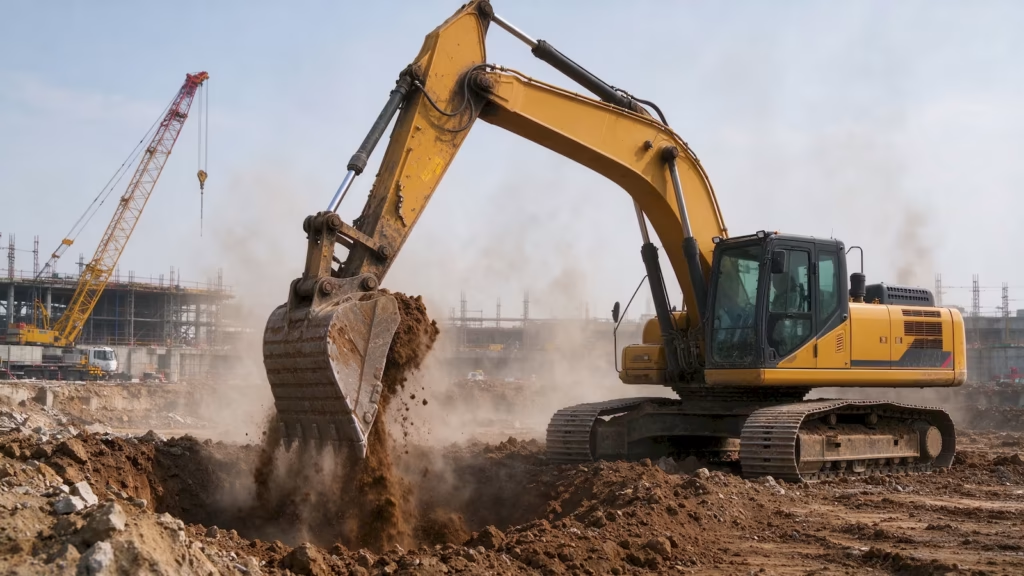
Excavators are some of the hardest-working machines on a jobsite. They dig, load, and move material under heavy load, run for long hours, and operate in an environment full of dust, heat, and shock loading. The engine oil they use must protect a heavy-duty diesel engine under sustained strain while resisting the contaminants that a construction site throws at it. For distributors and fleet buyers, understanding excavator oil requirements—viscosity, specification, and change intervals—is the difference between reliable uptime and expensive breakdowns.
Why Excavator Oil Is Different
An excavator’s diesel engine works at high load for long periods, often at low speed while lifting, so the oil carries heavy soot and experiences high thermal stress. It also operates in dusty conditions that increase wear. Because the machine is stationary much of the time, the oil never gets the benefit of long highway runs to clean itself. This duty cycle demands an oil with strong detergency, high soot-handling capability, good shear stability, and protection against wear under load. A passenger-car oil is completely unsuitable; excavators need heavy-duty diesel engine oil.
Viscosity Selection
The standard viscosity for most excavator diesel engines is SAE 15W-40, which provides the film strength needed under load across a wide temperature range and is the most widely used heavy-duty grade. In colder regions or winter construction, operators step down to 10W-30 or 5W-30 for easier cold starts. In very hot climates or for machines with high hour counts, some operators use 20W-50 for extra film strength at high temperature, though this is a temporary measure rather than a preferred choice. The governing rule is the manufacturer’s operator manual: match the viscosity to the ambient temperature and the engine’s stated requirement.
| Ambient Temperature | Recommended Viscosity | Typical Regions |
|---|---|---|
| Below about 10 °C / winter | 10W-30, 5W-30 | Cold and high-latitude regions |
| Temperate, year-round | 15W-40 | Most regions |
| Very hot climates | 15W-40 (sometimes 20W-50) | Tropical and desert regions |
Specifications: API and ACEA
Modern excavator diesel engines need an oil that meets a current heavy-duty API category. API CK-4 is the current category for modern engines, and API CI-4 remains widely used; API FA-4 is the fuel-economy-oriented category for engines built to accept it. On the ACEA side, classes such as E7 and E9 are relevant for heavy-duty diesel engines. Many manufacturers also publish their own approvals—for example, Caterpillar specifications such as ECF-2 (for older engines) and ECF-3 (for current engines), or Komatsu specifications. When selecting oil, check the excavator’s manual for the required API category and any OEM approval, and do not substitute a lower category for a modern engine, because it will not provide the required soot control and emission-system protection.
Oil Change Intervals and Oil Analysis
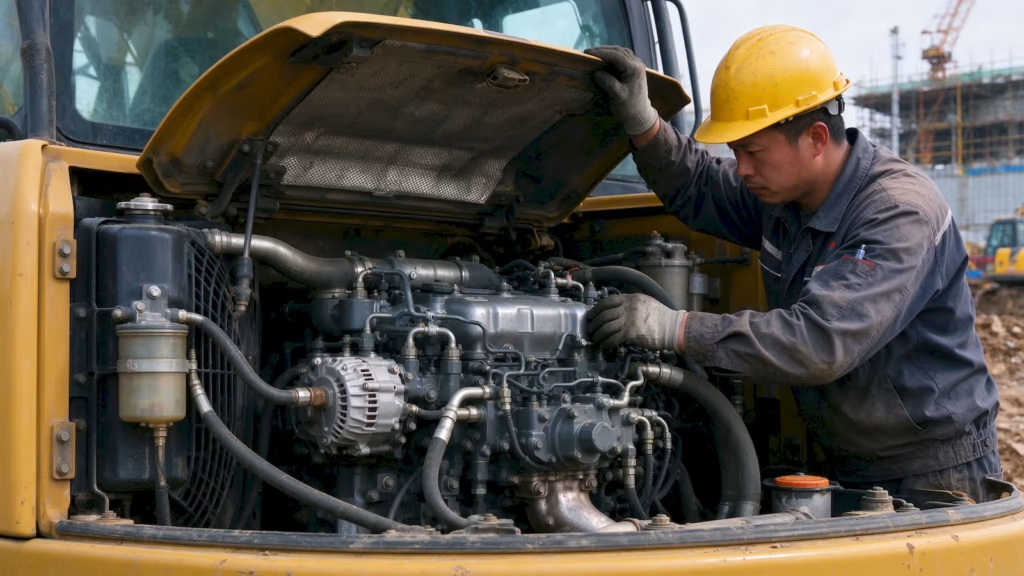
Excavator engine oil change intervals are typically given in operating hours. A common interval is 250 hours for the engine oil and filter, though some manufacturers specify up to 400 hours for cleaner-running, lower-load applications, and severe conditions shorten the interval. Always replace the oil filter at the same time as the oil, and pre-fill the new filter with clean oil to avoid a dry start. Because soot load and wear vary with duty, a used-oil analysis program—tracking viscosity, soot, TBN, and wear metals—tells you when the oil is genuinely ready for a change, protecting the engine while avoiding unnecessary changes.
Other Fluids on the Excavator
An excavator uses more than engine oil, and buyers should understand the full fluid picture. The hydraulic system uses hydraulic oil, commonly ISO VG 46 or ISO VG 68 (and ISO VG 32 in some cold-climate systems), with a change interval often around 1,000 hours or per the manufacturer. The swing and travel gearboxes use a gear oil, typically API GL-4 or GL-5 in a SAE 90 or similar grade. The final drives and tracks have their own lubricants and greasing points. Selling or managing an excavator means covering engine oil, hydraulic oil, gear oil, and grease—a complete program protects the whole machine, not just the engine.
| Fluid | Typical Grade | Typical Change Interval |
|---|---|---|
| Engine oil | SAE 15W-40, API CK-4/CI-4 | ~250 hours (with filter) |
| Hydraulic oil | ISO VG 46 / VG 68 | ~1,000 hours or per OEM |
| Gear oil (swing/travel) | API GL-4/GL-5, SAE 90 | Per OEM schedule |
Buying Considerations for Construction Fleets
When buying engine oil for excavators, choose heavy-duty oil that meets the machine’s API category and any OEM approval, stock the correct viscosity for the region, and buy in bulk to control cost while matching packaging to how the fleet dispenses oil. Require a certificate of analysis and confirm the supplier can deliver consistently across batches. Provide clear guidance on change intervals and oil analysis to reduce wear and downtime. A distributor who understands the full fluid program—engine, hydraulic, gear, and grease—becomes a trusted partner for construction fleets, turning a consumable into a steady, profitable line.
Excavators need heavy-duty engine oil that handles sustained load, heat, and contamination. Use a current API category (CK-4 or CI-4) in SAE 15W-40 for most conditions, step down in cold climates, and manage change intervals with hour meters and oil analysis. Understand the whole fluid program—engine, hydraulic, gear, and grease. When you match the oil to the machine and the duty, excavators run reliably and last longer.