
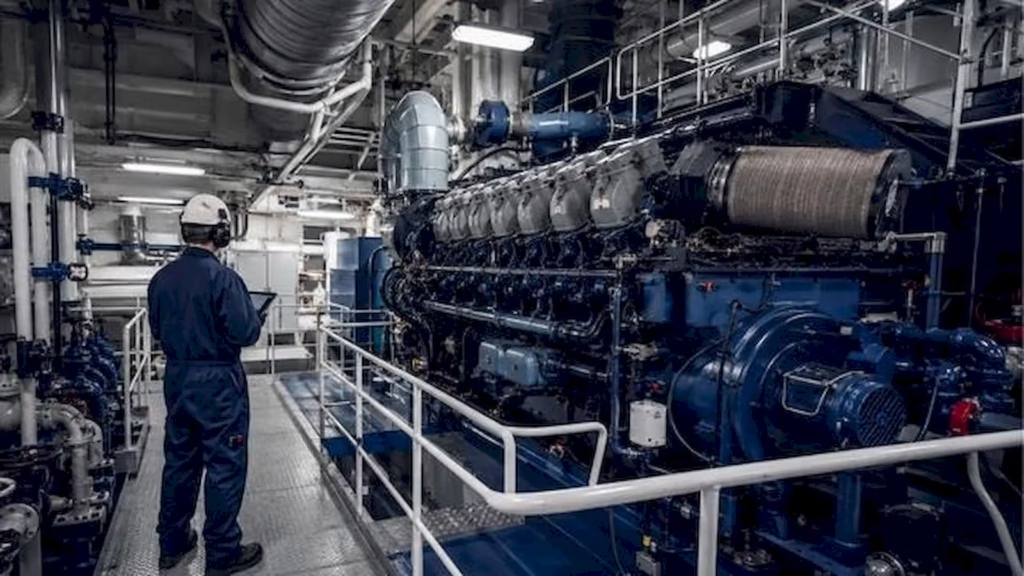
Marine diesel covers everything from a 40-metre fishing boat with a high-speed auxiliary engine to a bulk carrier with a slow-speed two-stroke main engine. The oils are not interchangeable and neither are the buying criteria. What they share is that a failure happens away from a workshop, and that the oil has to survive storage in a humid, salt-loaded space.
Suppliers who treat marine business as truck business with a different label tend to lose it at the first port state inspection or the first cylinder liner scuff. The specification conversation has to start with the engine type and the fuel, not with the viscosity.
| Engine type | Typical oil family | What drives the choice |
|---|---|---|
| High-speed auxiliary, 4-stroke | API CF, ACEA E5 | Fuel sulphur, load factor, hours |
| Medium-speed, 4-stroke | TBN 30 to 40 trunk piston oil | Fuel sulphur, liner wear, BN reserve |
| Slow-speed, 2-stroke crosshead | System oil plus cylinder oil | Separate circuits, BN matched to fuel |
| Small craft and fishing | API CF or CD, 15W-40 | Simple engines, mixed fuel quality |
The crosshead two-stroke is the case that catches buyers out, because it uses a system oil for the crankcase and a separate cylinder oil for the liners, and the two are not substitutes. A supplier who ships one drum for both has not understood the engine.
Total base number is the reserve an oil keeps for neutralising the acids that come from sulphur in the fuel. High-sulphur heavy fuel oil needs a higher TBN, and low-sulphur distillate needs less. Since the 2020 sulphur cap pushed most deep-sea fuel to 0.5 percent, some operators have moved to lower-TBN oils, but the change has to follow the fuel actually bunkered, not the fuel that was expected.
- A TBN that is too low for the fuel allows acid attack on the liners and shows up as a rising iron and a falling BN in the analysis.
- A TBN that is too high for a low-sulphur fuel can leave ash deposits and valve problems, particularly in four-stroke auxiliaries.
- Mixing oils of different TBN in one tank is a shortcut that ends in a BN nobody can predict.
- The fuel certificate is the document that decides the TBN, so ask for it with every bunker, not once a year.
A marine analysis is a trend, not a single number. Iron and copper rising together suggest wear at a bearing; sodium and potassium rising together suggest water or coolant ingress; a viscosity that climbs suggests oxidation or soot; a viscosity that falls suggests fuel dilution. Water in a marine sump is close to normal in small quantities and alarming above a threshold the engine maker sets.
The oil supplier’s job is to provide the baseline: the virgin oil values for BN, viscosity, flash point and water, on the same methods the lab uses. Without a baseline, a lab report is a set of numbers with no reference.
- Drums stored on deck collect water in the chime and rust at the closure. Store under cover, on dunnage, with the bung up.
- A drum that has been opened must be resealed and used first. Part-used drums in a humid engine room pick up water quickly.
- Bulk deliveries through a hose need a clean line and a sample at the receiving tank; a contaminated line undoes a clean cargo.
- Labels fade in salt air. Mark the grade and the batch number on the drum body as well as the label.
At the supply end, the pack choice follows the vessel. Fishing boats and small craft take 20-liter pails and 208-liter drums. Larger vessels take drums in slings or bulk in flexitanks, and the delivery has to match the crane and the manifold at the berth, not the supplier’s usual pallet.
- Engine make, model, rated speed and whether it is a trunk piston or crosshead design.
- Fuel type and sulphur content from the bunker certificate.
- Current oil, its TBN and its analysis trend if available.
- Delivery port, berth constraints and whether drums, pails or bulk are needed.
- Whether the vessel needs cylinder oil as a separate line item.
If-then: if the fuel is high-sulphur heavy oil, then specify a trunk piston oil with the TBN the engine maker requires, not a generic 15W-40. If the engine is a slow-speed crosshead, then quote system oil and cylinder oil as two products. If the vessel bunkers low-sulphur distillate, then confirm with the engine maker before dropping the TBN. If the drums are stored on deck, then specify a coated drum and a desiccant, or deliver in pails instead. If there is no baseline analysis, then supply virgin-oil values before the first sample is sent.
Supplying marine diesel operators and need trunk piston, system and cylinder oils quoted on one sheet with the right TBN for the fuel? Send the engine list, the bunker sulphur and the delivery port, and we will return the product lines and pack options.
Can a truck oil be used in a marine auxiliary engine?
Sometimes, if the category and TBN match the fuel and the load. It is not a safe default, because marine auxiliaries often run on fuel with a sulphur content a truck engine never sees.
Is higher TBN always better?
No. It has to match the fuel. Too little leaves acid attack; too much can leave ash deposits, especially in four-stroke auxiliaries on low-sulphur fuel.
How often should the oil be analysed?
At a regular interval set by the engine maker, and always after a fuel change, a long idle period or a water ingress event. The trend matters more than any single sample.
References and Further Reading
- International Maritime Organization – sulphur limits in marine fuel
- API – engine oil service categories
- ACEA – European oil sequences
The engine-side requirements are in common engine oil requirements for marine diesel engines, the specification walk-through in marine diesel specifications and buying considerations, the selection guide in how to choose engine oil for marine diesel engines, and the inspection side in quality inspection for importers.