
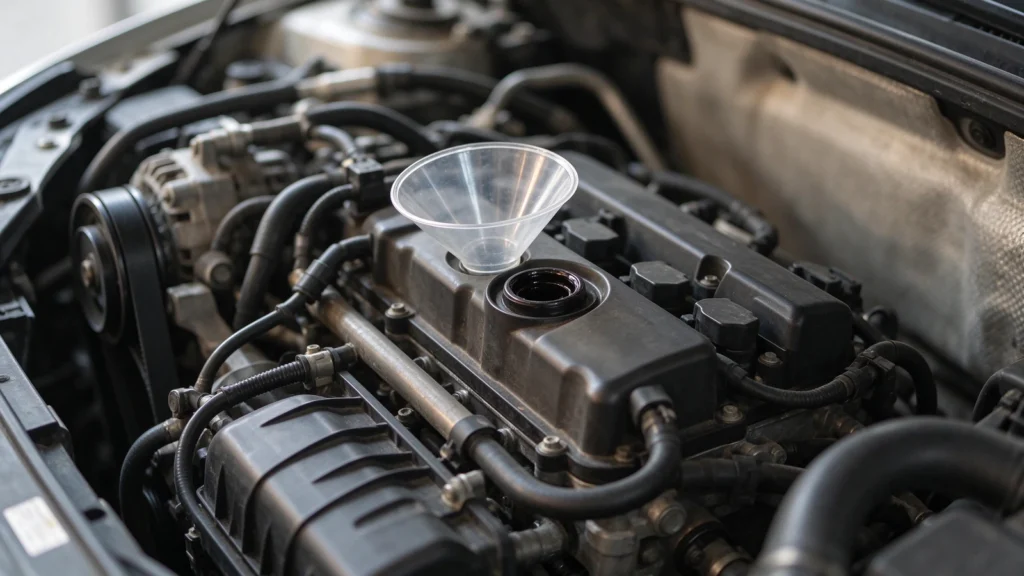
Every engine consumes some oil, and the number on the dipstick matters less than the route the oil took to leave. Six paths account for almost all of it: past the rings, past the valve guides, through the crankcase breather, past a turbo shaft seal, by evaporation, or through a leak. Each one leaves a different trace, and each one responds to a different fix.[1][2]
If Consumption Is Steady and Low, Rings Are Doing Normal Work
The oil control ring cannot scrape the cylinder wall perfectly dry; a thin film is left behind to lubricate the next stroke, and a fraction of it burns. A small four-cylinder engine may use 0.1–0.3 litres per 1,000 km this way, and many manufacturers accept up to a litre per 1,000 km before calling it a fault.[1] High load raises it, because more gas pressure pushes oil past the top ring and more heat thins the film. A steady figure that tracks duty cycle is normal; a figure that doubles between two drains is not.
If Consumption Appears After a Change, Check the Breather First
A blocked or stuck PCV valve raises crankcase pressure, and the pressure finds the weakest seal rather than the designed path. The symptom is oil pushed past the rear main seal, oil in the intake tract and a misted intercooler. On a turbocharged engine, the same crankcase pressure can overwhelm the turbo drain and push oil past the shaft seal into the compressor side.[2] A breather check costs minutes: pull the hose, confirm flow, and look for emulsion in the pipe. It is the first thing to rule out before quoting rings.
If the Oil Is Thin and Volatile, Evaporation Is Part of the Loss
Low-viscosity oils that pass fuel economy tests also tend to have higher volatility, and volatility is measured as NOACK mass loss at 250 °C. A 0W-20 built to a 13 percent limit can lose more mass to the crankcase atmosphere than a 5W-40 built to a 10 percent limit, and that vapour leaves through the breather.[3] Over a long drain in a hot engine bay the litres add up. The counter-move is not to jump two grades, but to choose a low-volatility product in the grade the handbook allows and keep the breather working.
If the Dipstick Drops Without a Wet Spot, Look at the Turbo
A seal that leaks into the exhaust leaves no puddle; the evidence is blue-grey smoke after idle and a compressor housing with oil film inside the intake pipe. Shaft play, restricted oil drain and excessive crankcase pressure all push oil past the same seal. On a variable-geometry turbo the actuator and the vanes add heat, and coking in the drain line is a common root cause.[4] Check the feed, the drain and the breather together before replacing the unit.
If You Want a Number, Weigh the Oil Instead of Reading the Gauge
A consumption complaint deserves a measurement: drain, weigh or measure the volume precisely, refill to the same mark, and repeat at 1,000 km with the same duty cycle. That turns three anecdotes into one figure. A leak-down test separates rings from guides, a compression test shows whether the loss is cylinder-wide, and an oil sample adds fuel dilution and coolant to the picture. Only then does the grade decision make sense, and only then can a claim be tested against the handbook limit.[5] High-mileage oil as a stock decision covers the commercial response.

| Consumption pattern | Most likely path | Quick check | Decision | How to verify |
|---|---|---|---|---|
| Steady, rises with load | Rings and cylinder wall[1] | Leak-down, compression | Accept if inside handbook limit | Weighed oil over 1,000 km |
| Sudden rise after a service | Breather or PCV[2] | Hose flow, emulsion check | Clean or replace PCV | Crankcase pressure reading |
| Thin oil, hot bay, long drain | Volatility loss[3] | NOACK on data sheet | Choose low-volatility grade | NOACK percent, oil level trend |
| Blue smoke after idle, no puddle | Turbo shaft seal[4] | Shaft play, intake oil film | Check drain before replacing | Drain line and breather |
| Wet spot under the vehicle | Seal or gasket | Visual, dye test | Repair the leak first | Pressure and dye trace |
Frequently Asked Questions
How much oil consumption is normal? It varies by maker; small petrol engines often sit at 0.1–0.3 litres per 1,000 km, and many handbooks set the fault limit near 1 litre per 1,000 km.[1]
Will a thicker oil stop consumption? It reduces loss past rings and guides, and does nothing for a blocked breather or a failed turbo seal.[2]
Why did consumption rise when I switched to 0W-20? Lower-viscosity oils are often more volatile, so more of the oil leaves as vapour through the breather.[3]
Can a new engine burn oil while it runs in? Yes, bedding-in leaves a rougher wall finish and higher consumption for the first few thousand kilometres.[1]