
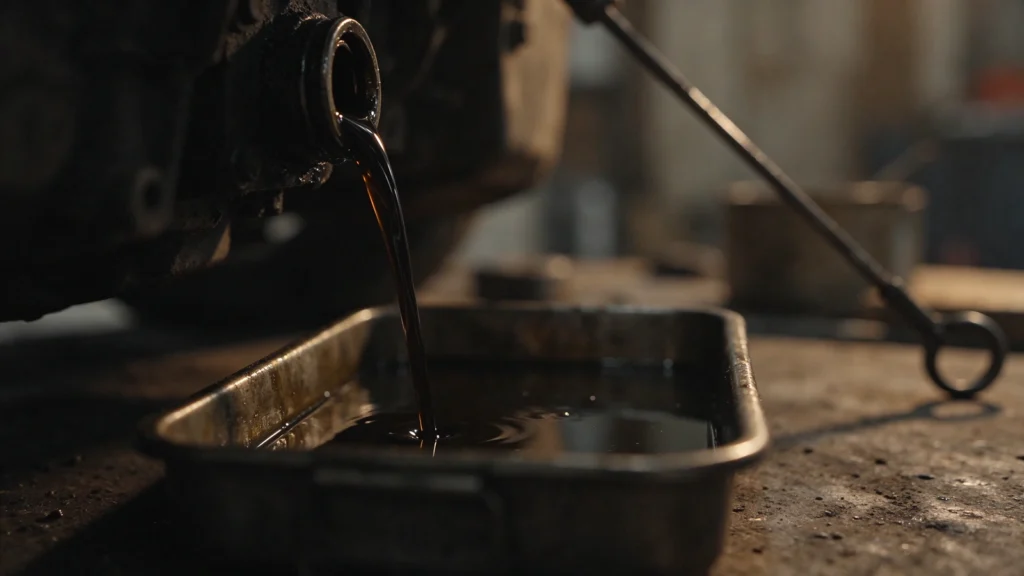
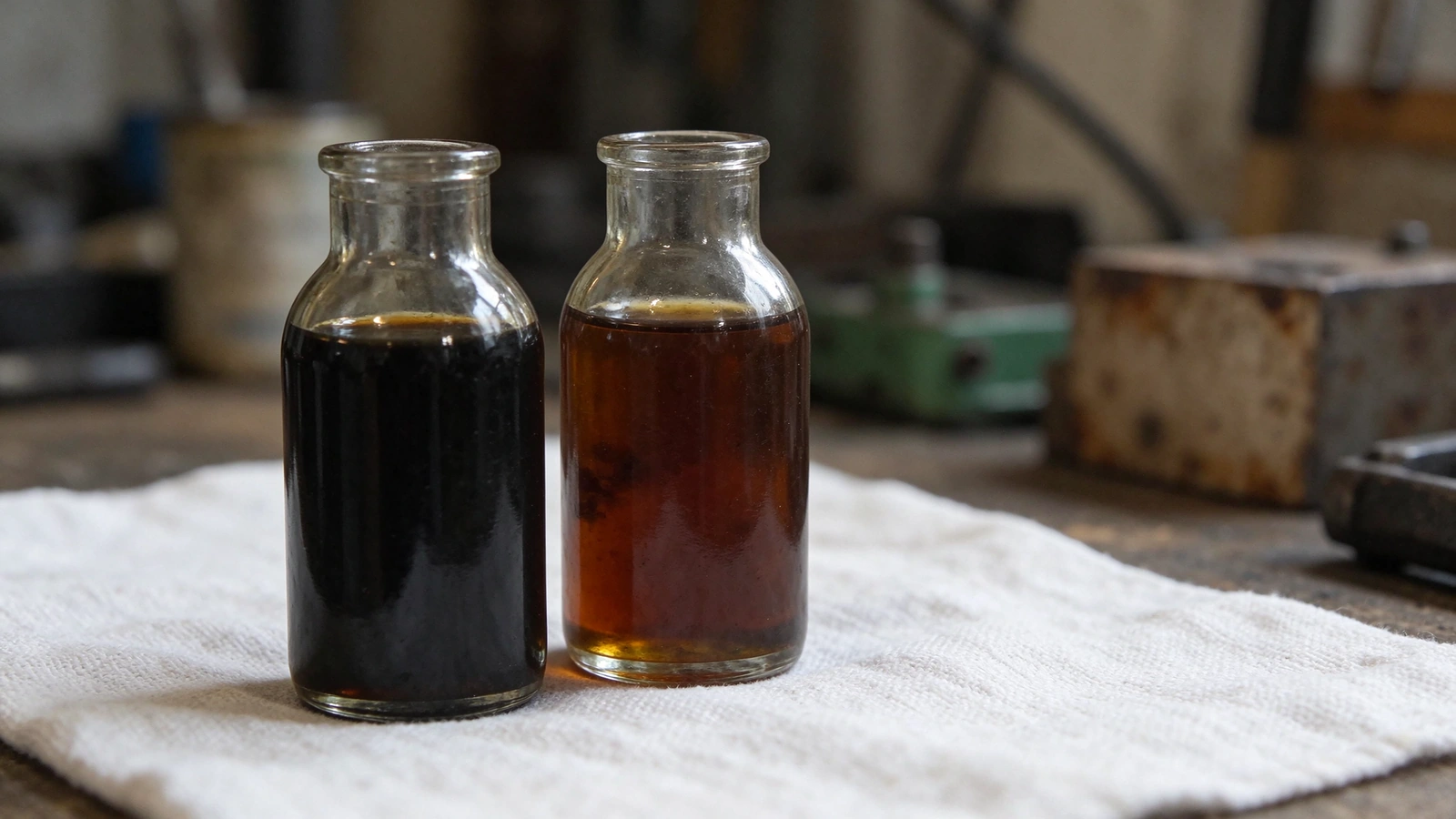
Oil that goes black in three thousand kilometres is doing part of its job, not failing at it. Colour is a side effect of soot, oxidation and additive chemistry, and a dispersant is designed to hold those particles in suspension so they drain out with the oil instead of baking onto metal. The useful question is not how dark the oil looks but what changed inside it.[1][2]
If the Engine Is a Diesel, Soot Is the Usual Reason for Colour
A diesel produces soot as a normal product of diffusion combustion, and a modern low-emission engine recirculates exhaust gas, which sends more of that soot into the sump. Fresh oil at 0.5 percent soot already looks dark on a white dipstick; by 2–3 percent it is opaque black, and that is still within the working range of most heavy-duty formulations.[2] Problems start when soot passes roughly 3 percent by mass, because the dispersant runs out of capacity, particles agglomerate and viscosity climbs. That is a soot issue, not a colour issue.
If the Engine Is Petrol, Varnish Forms Before Colour Changes
Gasoline engines make far less soot, so dark oil in a petrol car usually points to oxidation or to blow-by. A direct-injection engine is the exception: it produces visible particulates at part load, and its oil darkens much faster than a port-injection engine of similar age. In both cases the early warning is smell and texture rather than colour — a hot, acrid note and a film that feels tacky instead of oily. By the time the varnish is visible on the dipstick, it is already forming on the piston skirts.[3]
If the Oil Darkens Within a Thousand Kilometres, Something Is Wrong
Fast darkening right after a change is a symptom with a short list of causes: coolant entering through a gasket or cooler, a rich mixture washing the cylinder walls, heavy blow-by past worn rings, or the wrong oil being used to top up. Coolant is the urgent one, because glycol and water turn oil into an emulsion that no additive can rescue. If the oil looks milky, smells sweet or rises on the dipstick, stop driving and pressure-test the cooling system before another kilometre.[4] How oil protects against wear, sludge and heat covers the failure chain in more detail.
If You Want a Verdict, Test Four Numbers Instead of Judging Colour
A used-oil report turns colour into evidence. Viscosity at 100 °C against the fresh value shows whether the oil has sheared thin or oxidised thick; a move beyond about 20 percent in either direction is a flag. TBN against the fresh figure shows how much acid-neutralising reserve is left. Water above 0.2 percent and any glycol reading are stop signals. Soot by infrared or thermal methods and wear metals by ICP complete the picture. Without those numbers, “dark” is an opinion.[5] How oil samples should be compared explains why the fresh reference matters.
If the Drain Interval Is Long, Colour Is a Poor Guide to Timing
Extended drains are built on oxidation stability and base number reserve, not on appearance. An oil can look black at half its interval and still hold full protection, or look amber at the end and be nearly out of alkalinity. Set the interval from the handbook, the fuel sulphur level and the duty cycle, then let sampling decide whether to extend it. Colour photography is useful for training a driver to notice a change, never for deciding when to drain.[6] Change intervals in miles, time and oil quality sets the commercial frame.
| What you see | Engine type | Likely cause | Action | How to verify |
|---|---|---|---|---|
| Black at 3,000–5,000 km | Diesel, EGR equipped | Soot held in suspension[2] | Continue, sample at mid-interval | Soot percent, viscosity |
| Black within 1,000 km of a change | Any | Coolant, rich mixture, blow-by[4] | Stop and diagnose | Water, glycol, compression |
| Milky or brown foam | Any | Coolant or water ingress[4] | Do not drive, pressure test | Water above 0.2 percent |
| Amber but thin and hot-smelling | Petrol, long drain | Oxidation, shearing[3] | Drain early, review interval | Viscosity drop, FTIR |
| Dark and thick with sludge on the cap | Any, short trips | Low-temperature deposits[3] | Shorten interval, fix thermostat | Sludge check, PCV flow |
Frequently Asked Questions
Does dark oil mean the oil is old? No. Diesel oil darkens within a few thousand kilometres by design, because soot is held in suspension.[2]
Should I drain as soon as the oil turns black? Only if it darkened abnormally fast or the level or texture changed; otherwise let sampling decide.[5]
Why is new oil sometimes dark in the bottle? Some formulations carry dye or a dark molybdenum additive; that is chemistry, not contamination.[1]
Can a dark oil still pass a lab test? Frequently yes, and that is exactly why colour alone should never set the drain point.[5]