

HTHS viscosity—high-temperature high-shear viscosity—is the property that tells you how well an oil can protect an engine at operating temperature under real mechanical stress. Unlike the simpler kinematic viscosity you see printed on the can, HTHS is measured at engine-like conditions: around 150 °C and a shear rate of one million reciprocal seconds. It is the number that most directly describes bearing protection, and it is often the missing piece when buyers compare oils by label alone. Understanding how to read and evaluate HTHS viscosity will help you choose oils that genuinely protect engines, not just oils that carry the right grade mark.
What HTHS Viscosity Is
HTHS viscosity is the resistance of the oil to flow at high temperature (nominally 150 °C) and high shear rate (10^6 s^-1, or one million reciprocal seconds), which are the conditions found in the main bearings and between the piston ring and cylinder wall under load. It is expressed in centipoise (cP) or millipascal-seconds (mPa·s). The higher the HTHS value, the stronger the oil film under load. This is the property that keeps metal parts from touching when the engine is hot and working hard.
Why HTHS Matters: Bearing Protection
At operating temperature, the oil film between moving parts must be thick enough to separate the metal surfaces. HTHS viscosity is the closest laboratory approximation of that film’s strength under the actual shear conditions in the engine. If the HTHS value is too low for the application, the film can collapse, leading to metal-to-metal contact, bearing wear, scuffing, and elevated temperatures. This is why heavy-duty and high-performance specifications set minimum HTHS requirements—to guarantee a minimum level of protection regardless of how the oil performs in the easier kinematic test.
SAE J300 HTHS Limits
The SAE J300 standard defines viscosity grades, and each grade carries a minimum HTHS viscosity at 150 °C. Representative minimums for common grades are:
| SAE Grade | Minimum HTHS (cP) at 150 °C |
|---|---|
| 0W-20 / 5W-20 | 2.6 |
| 0W-30 / 5W-30 / 10W-30 | 2.9 |
| 5W-40 / 10W-40 / 15W-40 / 20W-40 | 3.7 |
| 0W-16 | 2.3 |
| SAE 40 (single grade) | 3.7 |
In addition, engine manufacturer and lubricant association specifications tighten these numbers for specific applications. For example, ACEA A3/B4 requires an HTHS of at least 3.5 cP for its heavy-duty protection oils, while lighter fuel-economy categories (such as ACEA C2/C5 and many ILSAC GF-6 products) are designed around lower HTHS values near 2.9 cP. When a buyer sees a low-HTHS grade like 0W-20, they are choosing fuel economy and are accepting a thinner film that is only safe in engines specifically designed for it.
How HTHS Is Measured: ASTM D4683, D4741 and D6616
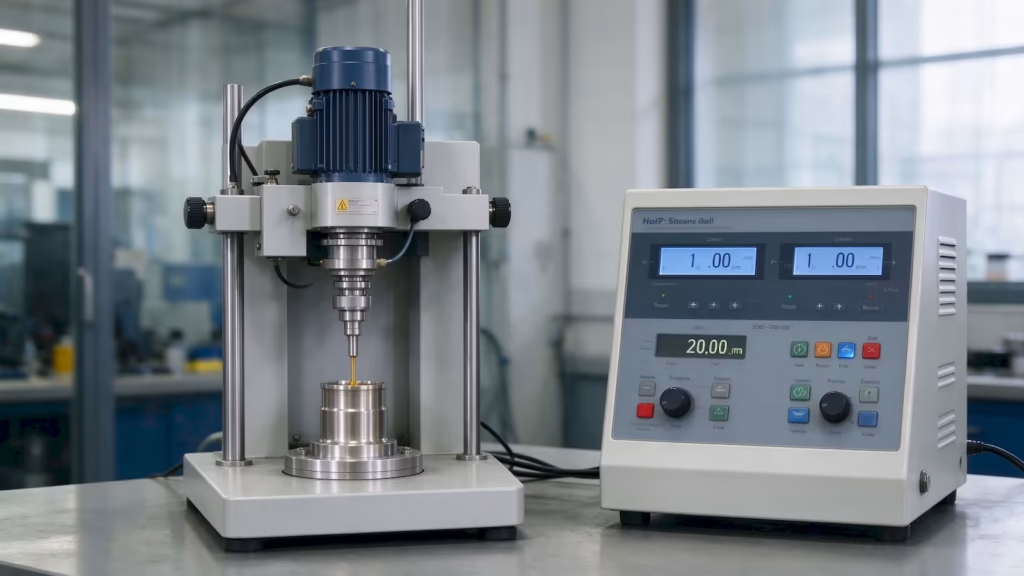
HTHS viscosity is measured with dedicated instruments rather than a simple viscometer. The three common test methods are:
| Method | Instrument / Principle | Notes |
|---|---|---|
| ASTM D4683 | Tapered bearing simulator (TBS) | Rotating a taper bearing; widely used in specification work |
| ASTM D4741 | Piston or capillary method under high shear | Measures viscosity at high shear in a controlled capillary |
| ASTM D6616 | Tapered bearing simulator (updated) | Refined version of the bearing simulator approach |
These methods replicate the high-temperature, high-shear environment of an engine bearing. When a technical data sheet lists an HTHS value, it should state which method was used, because the instruments give slightly different results. Any of the three is acceptable when reported clearly, but you should not compare values measured by different methods without noting the difference.
HTHS vs Kinematic and Low-Temperature Viscosity
It is easy to confuse the three viscosity numbers on a data sheet, so it helps to separate their roles. Kinematic viscosity (KV100), measured with a simple viscometer at 100 °C, describes general flow and is the basis of the SAE grade. Low-temperature properties (such as cold cranking simulator viscosity and pumping viscosity) describe how the oil behaves when the engine is cold and needs to start. HTHS viscosity describes the film under hot, loaded conditions. A product can have a perfectly normal KV100 and still have a low HTHS, so you cannot infer HTHS from the grade mark alone—you must read the HTHS number directly.
What to Check in a Technical Data Sheet
Before you buy, pull the product’s technical data sheet and find these values: the HTHS viscosity at 150 °C in cP, the method used (D4683, D4741 or D6616), the kinematic viscosity at 100 °C, and the viscosity grade. Then check them against the application: for a heavy-duty diesel engine, look for an HTHS at or above the grade minimum (3.7 cP for a 15W-40) and, ideally, an ACEA or API category that guarantees it. For a modern fuel-economy passenger car oil such as a 0W-20, an HTHS near 2.6–2.9 cP is normal and expected, provided the vehicle is designed for it. If the sheet does not report HTHS at all, treat that as a warning and ask the supplier for the value.
Buying Guidance and Common Mistakes
Three mistakes are common among buyers. The first is choosing an oil for a heavy-duty or high-performance engine based only on the SAE grade, without checking that the HTHS meets the engine manufacturer’s requirement—a 10W-30 with an HTHS of 2.9 cP is not a substitute for a 15W-40 with 3.7 cP in a loaded diesel. The second is assuming a higher HTHS is always better; in an engine designed for a low-viscosity, low-HTHS oil, an overly thick film adds drag and wastes fuel. The third is ignoring the test method, comparing D4741 results to D4683 results as if they were identical.
HTHS viscosity is the quiet number that determines real-world bearing protection. Learn to read it, match it to the application, and demand it on the data sheet. When you evaluate HTHS before you buy, you stop choosing oils by marketing and start choosing them by the property that actually protects the engine.