
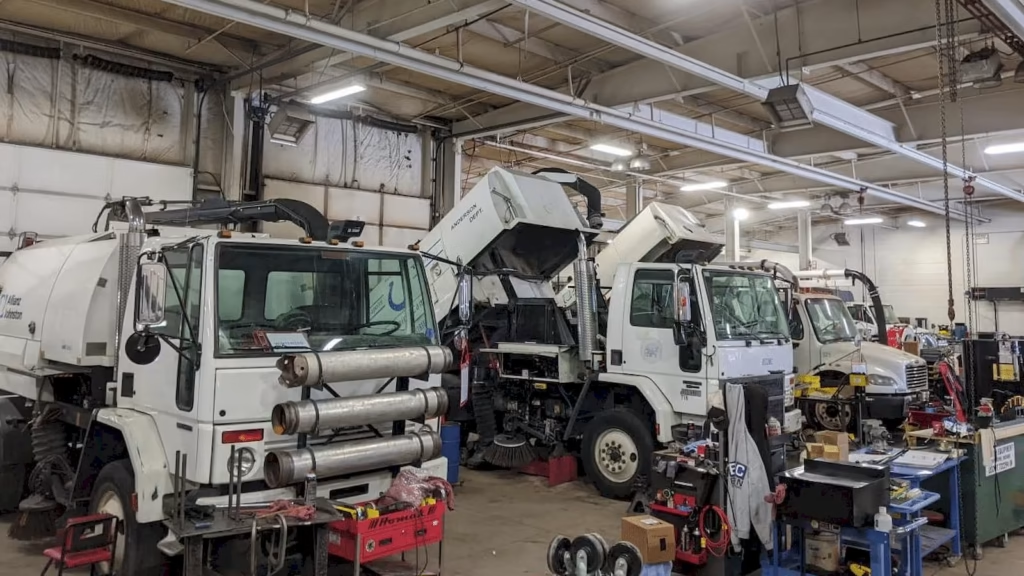
A refuse truck spends its life doing the opposite of what an engine oil test cycle assumes. It covers thirty to sixty kilometres in a shift, stops three hundred times, runs the packer on power take-off for hours, and comes home with the engine never reaching a steady high load. The oil still has to hold its grade, keep the engine clean and survive a drain interval counted in hours rather than distance.
Three conditions arrive at once. The engine lives below forty percent load, so exhaust temperature stays low and the particulate filter gets little heat. Hundreds of thermal cycles per shift mean repeated cold starts with fuel-rich combustion and condensation in the crankcase. The packer hydraulics load the engine at fixed speed through the PTO, adding heat without adding distance.
- Soot builds faster than the odometer suggests, because soot is produced per unit of fuel burned and much of that fuel burns at low efficiency.
- Water and fuel dilution accumulate, because the oil rarely runs hot long enough to evaporate them.
A refuse vehicle is not one oil purchase but four or five, and the costliest failures are usually hydraulic and grease failures caused by a misfill or a product chosen on price alone.
| System | What the specification should state | Typical value in a refuse fleet | What goes wrong when it is wrong |
|---|---|---|---|
| Engine | ACEA E6 or E9, or API CK-4, plus the OEM approval on the engine plate | 5W-30 or 10W-40 low-SAPS on Euro VI; 15W-40 CK-4 on older fleets | DPF ash loading, sludge from stop-start, a warranty dispute |
| Automatic transmission | The approval printed on the transmission plate, not a multi-vehicle claim | OEM-specific approval where an automatic is fitted | Shudder, converter wear, an overhaul at half life |
| Hydraulic oil for packer and bin lifts | ISO 11158 HM or HV, grade fixed by the body builder | ISO VG 46 anti-wear, VG 32 for hard winter | Slow packer cycles, valve erosion, seal leaks, pump wear |
| Biodegradable hydraulic option | ISO 15380 HEES where a leak can reach a drain or watercourse | HEES VG 46 with seal and interval advice | An environmental incident plus an unplanned fluid change |
| Grease for rams, bearings and bin lift | NLGI 2, EP lithium complex, water resistant | NLGI 2 EP for chassis and packer bearings | Seized bearings, snapped pins, a body repair worth a year of grease |
Each line has to be checkable. High quality hydraulic oil cannot be checked. ISO 11158 HM, VG 46, batch certificate and viscosity index above 100 can be checked against a delivered drum in ten minutes.
Depot experience puts the expensive failures in two places, and neither is the engine.
- The packer hydraulics get topped up with engine oil because a driver found a drum on the same pallet. The viscosity is close enough to keep the machine moving and different enough to destroy the pump over a season.
- Grease intervals are set by calendar rather than duty. A truck packing four hundred bins a shift articulates its bearings far more than the mileage suggests.
- List each system separately with its own standard, viscosity grade and OEM approval where one exists.
- Require a batch certificate per delivery with viscosity at 40 and 100 degrees Celsius, viscosity index, flash point and the elemental additive markers.
- State the packaging per system, because a depot receiving hydraulic oil in drums and engine oil in pails has already halved the misfill risk.
- Name who pays for the flush, the downtime and the disposal when a delivery does not conform.
The last item is the one buyers leave out. A drum of the wrong grade delivered into a hydraulic system is not a returns problem, it is a maintenance event, and the cost sits with whoever accepted the delivery.
If-then: if the fleet is under an OEM maintenance contract, then the specification is fixed and the decision is only price, packaging and delivery reliability. If the fleet is maintained in-house, then the buyer owns the specification and has to verify it on every delivery. If the depot cannot say how many engine hours a truck does per shift, then the drain interval is set by habit and the first oil sample is the first real information the depot has had.
Specifying oil for a refuse fleet or a municipal tender and need the four systems matched to the body and the duty cycle, with batch certificates and packaging that prevents a misfill? Send the chassis models, the body builder and the shift pattern, and we will build the specification around them.
Can a 15W-40 be used in a Euro VI refuse truck?
Only if the engine manufacturer allows it. Euro VI engines with aftertreatment usually call for a low-SAPS oil meeting ACEA E6 or E9 at the grade in the manual, and a higher-SAPS oil can load the filter with ash that never burns out.
Should the drain interval be based on kilometres?
Rarely here. Refuse trucks accumulate engine and PTO hours far faster than distance, so the manual’s hours or fuel basis is correct and sampling confirms whether it is conservative or too long.
Is biodegradable hydraulic oil worth the cost?
Where a hose failure or packer leak can reach a drain or watercourse, yes. The cost is the fluid plus a seal compatibility check; the alternative is a cleanup bill and a report.
How many oil products should a depot standardise on?
One per system, with two hydraulic grades at most where winter demands it. Every extra near-identical product is a misfill waiting for a busy shift.
References and Further Reading
- API – engine oil categories and licensing
- ACEA – European oil sequences
- ISO – lubricant classification standards
The application requirements are set out in common engine oil requirements for waste collection trucks. The same duty-cycle logic is in engine oil for city buses, the multi-depot supply structure in building a reliable fleet engine oil supply, and the packaging decision in choosing between bottles, pails and drums.