
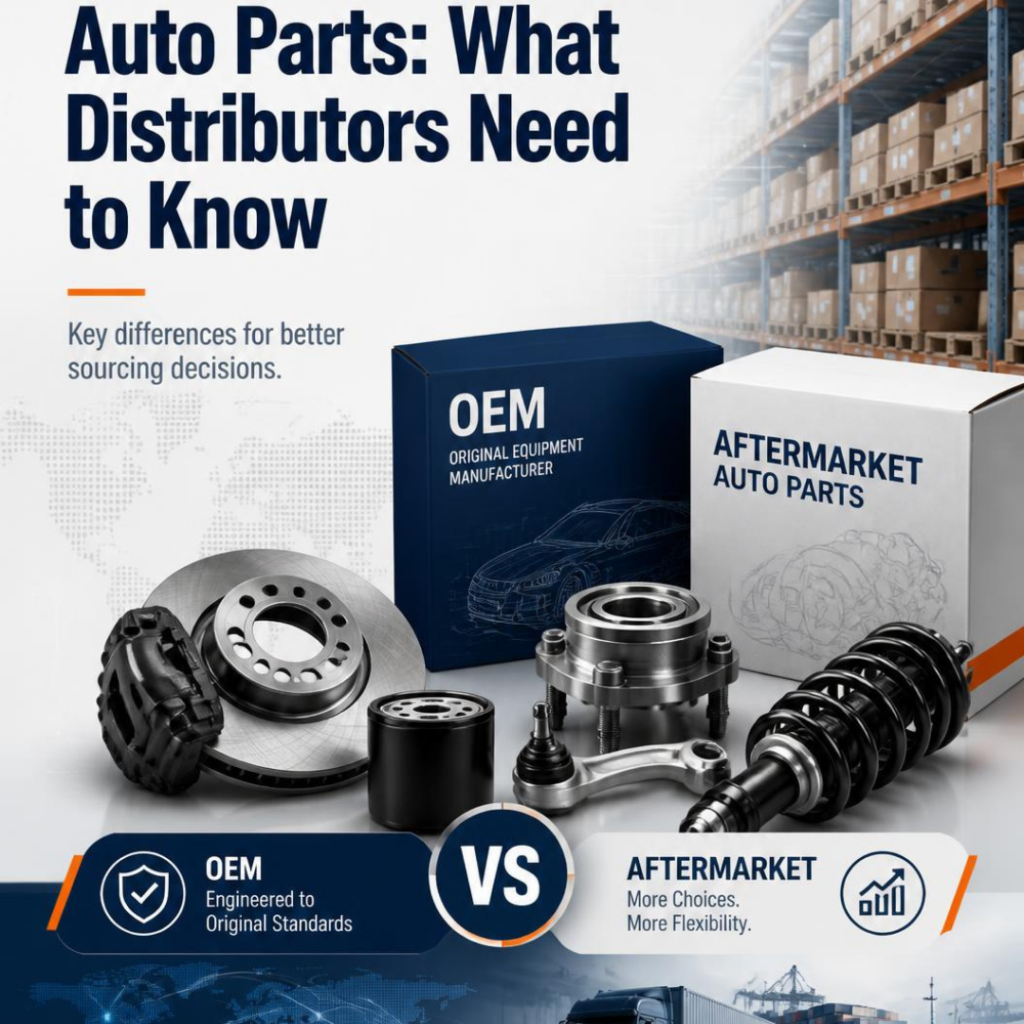
For automotive distributors and wholesalers, choosing between OEM and aftermarket auto parts is an important decision that directly affects product positioning, pricing strategy and customer satisfaction.
Both OEM parts and aftermarket replacement parts have their own advantages. Understanding the differences can help businesses build a more efficient sourcing strategy and provide better solutions for different customers.
What Are OEM Auto Parts?
OEM stands for Original Equipment Manufacturer. OEM auto parts are produced according to the specifications of the original vehicle manufacturer or by manufacturers that supply components for original equipment production.
These parts are designed to match the original vehicle specifications in terms of dimensions, materials and performance requirements.
For customers who prioritize original specifications and direct replacement, OEM parts are often considered a reliable option.
What Are Aftermarket Auto Parts?
Aftermarket auto parts are replacement components produced by independent manufacturers rather than the original vehicle brand.
These products are designed to replace original components after vehicle production and are widely used in the automotive aftermarket industry.
A professional aftermarket supplier focuses on maintaining product compatibility, quality standards and cost efficiency for different vehicle applications.
Key Differences Between OEM and Aftermarket Parts
| Factor | OEM Parts | Aftermarket Parts |
|---|---|---|
| Manufacturer | Original equipment supplier or vehicle manufacturer | Independent automotive parts manufacturers |
| Specification | Designed according to original vehicle specifications | Designed to replace original components |
| Price | Usually higher due to brand and original supply chain costs | Usually more competitive for distributors |
| Availability | May have limited supply channels | Usually available through wider aftermarket networks |
| Product Choice | Limited to original specifications | More options from different manufacturers |
Why Many Distributors Choose Aftermarket Auto Parts
For global automotive distributors, aftermarket parts provide several business advantages.
- Competitive Pricing: Aftermarket products usually offer better cost control, allowing distributors to create more flexible pricing strategies.
- Wide Product Coverage: Independent suppliers can provide replacement parts for many vehicle brands and models.
- Better Business Flexibility: Distributors can select different product levels based on customer requirements.
- Private Label Opportunities: Many aftermarket suppliers support customized packaging and brand development.
How to Choose the Right Auto Parts Strategy for Your Market
Different customers have different requirements. A successful distributor should understand the target market before selecting products.
For Premium Vehicle Customers
Some customers may prefer OEM-equivalent products because they focus on original performance and specifications.
For General Repair Markets
Aftermarket products are often more suitable because repair shops and distributors need reliable replacement parts with reasonable costs.
For Brand Builders
Companies looking to develop their own automotive brands may benefit from working with suppliers that provide OEM and private label solutions.
Quality Standards Matter More Than Product Labels
The difference between OEM and aftermarket does not automatically determine product quality.
A professional aftermarket manufacturer can produce reliable components through strict quality control, advanced manufacturing processes and proper testing procedures.
When selecting suppliers, distributors should focus on:
- Manufacturing capability
- Quality inspection process
- Vehicle application data
- Export experience
- After-sales support
Conclusion
OEM and aftermarket auto parts both play important roles in the global automotive market.
For distributors, the best sourcing strategy is not simply choosing OEM or aftermarket products, but finding the right balance between quality, cost, availability and customer demand.
Working with an experienced automotive parts supplier can help businesses build a stable supply chain and create long-term growth opportunities in the aftermarket industry.